How to Efficiently Track and Schedule Your Food Delivery Like a Pro
In today’s fast-moving world, operating food delivery entails more than just vastly cooking meals; it calls for a preprocess that is systematically organized to track orders and schedule deliveries so that every client has a customer life that is easy. Whether you are managing a ghost kitchen, a meal-kits startup, or you simply want to have dinner at the most excellent restaurant on time, something that sets you apart like a real pro should be the whole process efficiently. This guide will teach you the core elements of delivery, tracking, scheduling, as well as optimizing your workflow, and you will also get some tips on what you can apply immediately — even if it is just for yourself.
1. The Importance of Tracking
Putative order tracking is the muscle of any food delivery business. It performs much more than informing you, for instance, “Where is my food?” by doing the following:
- Bridges Trust: Instant status reports take your customers’ minds off worries on their orders not being on the way.
- Lowers Inquiries: Transparent status updates help you cut the number of calls or chats asking “Where is my order?”.
- Increases Accountability: You will be able to determine which drivers, routes, or bottlenecks in the kitchen are responsible for delays.
- Highlights Data: Metrics on tracking will unveil tight spots in your operations and hence are the foundation of continuous improvement.
Other locales — akin to HMD Bar&Grill: Restaurant in places that deliver in Chicago Ridge — employ level SMS ups solely to inform their patrons of when their special burgers are off the floor. The use of display pages rules on the web or messengers with the addition of push notifications of the state of orders can reflect any kitchen or courier service from “just another delivery” to, let’s say, a professional and pro‑level experience.
2. The Best Tools for Real-Time Tracking
Selecting the ideal software to track your food deliveries can be a source of confusion. Underneath is a comparative analysis of the best delivery service tools and the most commonly used by home cooks:
| Tool | Key Feature | Best For |
| Google Maps | Live ETAs, turn‑by‑turn reroutes | Simple, low‑cost tracking |
| Route4Me | Automated route optimization | Multi‑stop, fixed schedules |
| Onfleet | Driver GPS, proof of delivery | Courier fleets |
| Zapiet | Scheduled delivery slots | Meal kits & grocery services |
| DispatchTrack | Real‑time monitoring + analytics | Business‑grade logistics |
- Google Maps is free and user-friendly—suitable If you need just simple tracking.
- Route4Me and DispatchTrack perform best with complex, multi‐stop runs where dynamic optimization is needed.
- Onfleet, although it is intricate, gives you the opportunity for in-depth analytics; this is especially useful when you scale up to dozens of drivers.
- In case of subscription-based or scheduled meal kits, Zapiet can be integrated into e-commerce platforms like Shopify and allow customers to choose the delivery of their desired time.
A solution is to get a tool that will be integrated with your ordering system and at the same time provide customer-facing tracking links you will be setting for your customers. This, in turn, will reduce the friction, empower the end-users, and will give you operational insights — all gathered into one.

3. Perfecting the Delivery Scheduling
A smart scheduling simultaneously pursues two goals: one is to leverage your capacity to the fullest and the other to ensure that the product quality is not affected. Here’s how you can achieve it at its best:
- Set Cut-off Times: State the last time-order customers can launch orders for same-day delivery.
- Create Delivery Windows: Provide either 1-hour or 30-minute slots, so customers are strictly notified on when they can expect their meals.
- Batch Orders Strategically: Accumulate orders which have a common route or a common time frame and thus save on driving miles.
- Balance Demand and Capacity: Be on the lookout for peak hours (lunch rush, dinner hour) and act accordingly by adjusting driver shifts.
- Encourage Flexible Windows: Offer a minor discount to clients that choose a more extensive window of opportunity for the delivery — this will, in turn, give you space for optimization.
By consistently informing about the scheduling options, you let your customers make decisions that will suit your logistics. This considered both customer experience and operational efficiency hence, consequently, transforming your delivery model into a highly professional, pro‑level service.
4. Making Tracking and Scheduling Talk to Each Other
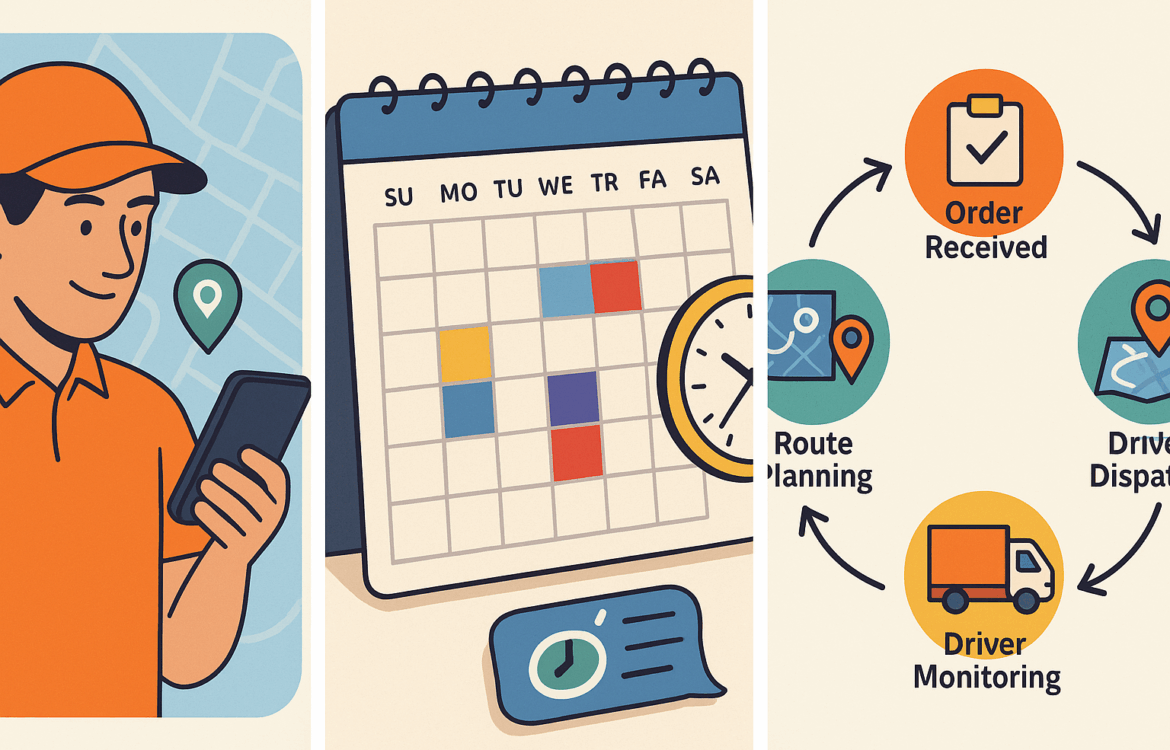
The real magic happens when your tracking and scheduling systems talk to each other. Here’s a simple workflow you can adapt:
- Order Received → Customer selects a delivery window via your online platform.
- Route Planning → Software batches orders within that window and generates optimized routes.
- Driver Dispatch → Drivers get turn‑by‑turn directions and a real‑time tracking link is sent to the customer.
- Live Monitoring → Dispatchers kin watch progress on a dashboard, identifying potential delays before they snowball.
- Post‑Delivery Survey → Automated follow‑up to gauge satisfaction and capture feedback for continuous improvement.
This uncommon conversation is the one which integrates both ends thus customers are always aware where and when their food would come, in return, you will get the data that you can use to upgrade your operations. The result will be fewer late deliveries, reduced obvious miles, and customers who are happier than ever feeling they are in control.
5. Expert Advice and Traps to Avoid
- Set Up Geofencing Alerts: Create geofenced zones around your kitchen and delivery zones. As soon as the drivers enter or exit these geofences, the automated status updates are triggered, and there is no need for manual input.
- Monitor Important Metrics: Be sure to measure the on time delivery percentage, the average delivery time, the miles driven per order, and the customer complaints per 100 orders. This will give you the key pointers to recognize any trends before they impact your service.
- Feature Real-Time Chat: Embed either a chat widget or in-app messaging so customers can briefly reach out to you with questions thus avoiding making calls. This keeps drivers on the road and the kitchens at focus.
- Driver Training on Customer Service: A simple wave and an estimated arrival time can make a good experience utter fantastic.
- Avoid Over-Stuffing the Routes: Don’t crowd the window too much with stops. Arriving Quality (i.e. hot food, fresh salads) if not red with 비rush.
Being consistently efficient in using these practices will not only allow your crew to get rid of the most common headaches created by pepper schedules and fragmented tracking solutions but also will re-engineer your operation to a sleek, scalable model that has an overall pro feel.
6. Case Study: From Florist to Your Kitchen
Do you remember the production manager with Florist that was in Vancouver and spent only 30 minutes daily to plan the routes? They used basic route-planning tools to consolidate orders and set delivery time blocks thus freeing more time for baking thousands of artisan goods. You too can think in that way:
- Batch wisely: Group orders by neighborhood, time window, or meal type.
- Automate early: Use a simple spreadsheet with formulas that work when you are starting—just map orders to zones and assign drivers.
- Scale thoughtfully: As the order volume grows, you can switch to dedicated logistics software.
Whether you are delivering freshly baked tarts or curries that only need heating, the trick is to treat your delivery network with as much care as you do the recipes.
Closing Remarks
The difference between a distressed kitchen and a fully functional delivery machine operating like a pro can only be the effective tracking and scheduling of your food deliveries. Properly carry out the tools selection and the definition of clear delivery windows, include the real-time tracking of the delivery, and proactive customer communication, all together they make the business operation and customer satisfaction like a breeze. The power of these strategies is so that they can increase your performance either if you are dispatching an order from HMD Bar&Grill: Restaurant in Chicago Ridge or running a meal kit service at a national level. Just take your time, keep on assessing your performance, and refine your processes till you realize it – you will be having as good logistics as a professional delivery expert.
Good luck, and happy delivering!
Leave a Reply